Where business mobile numbers come from, what tools like Prospeo, FullEnrich, Kaspr, Lusha and Cognism cost per number found, how to verify numbers and how to stay within the GDPR.
Short answer: the fastest way to find business mobile numbers for B2B prospects is a contact data provider such as Prospeo, Lusha, Kaspr, Cognism or Apollo, or a waterfall tool such as FullEnrich or Clay that queries several providers in sequence. Start from a verified work email and LinkedIn profile, look up the mobile, verify it before dialling, and check the calling rules in the prospect’s country. This guide explains each method, what the main tools cost per number found, and how to stay within the GDPR.
Phone is still the channel where most B2B conversations actually happen, and it’s the core of how our BDRs work. But a cold-calling campaign is only as good as its numbers. Too many switchboards, outdated mobiles or numbers of people who left the company, and your callers spend the day on hold instead of in conversations.
Company numbers, direct dials and mobile numbers
“Phone number” can mean three different things, and they’re not equally useful or equally easy to find.
Phone numbers in B2B
Three kinds of numbers, three different jobs
Easy to find
Company number
The main line or switchboard. Public and easy to find, but you’ll often reach reception first.
Moderate
Direct dial
A personal landline extension at the office. Reaches the person at their desk, if they’re in.
Hardest to find
Business mobile
The number the person carries. Highest chance of reaching them, hardest to find and the most sensitive data.
Company numbers are on the company website, in Google Business Profiles and in registries. Direct dials and mobile numbers are rarely public. They come from contact data providers, who collect them from sources such as user-contributed address books, partner data and public profiles, and from the prospect themselves (email signatures, earlier conversations).
Ways to find a prospect’s mobile number
1. Contact data platforms
Databases such as Prospeo, Apollo, Lusha, Kaspr and Cognism let you search for people by role, company and region, or look up a specific person, and reveal their contact details for credits. Most have a Chrome extension that works on LinkedIn profiles.
2. Waterfall enrichment
No single provider has every number. Waterfall tools query several providers in sequence and stop when one returns a result. FullEnrich says it uses more than 20 sources and only charges for verified results. Clay lets you build your own waterfall from the providers in its marketplace; since its March 2026 pricing change, Clay doesn’t charge for lookups that return nothing. BetterContact works the same way.
3. The prospect themselves
The most accurate source is often the simplest: email signatures, earlier email threads, a number shared in a LinkedIn conversation or on a business card. If a prospect replies to an email, it’s normal to ask whether a call would be easier.
4. Company channels
Calling the main line and asking for the person still works, especially at smaller companies and in markets where reception routes calls willingly. It’s slower, but it’s also a chance to learn who actually owns the topic.
What we don’t recommend: buying unverified lists of unknown origin, or using people-search sites built for consumer lookups. Neither gives you a defensible source for the data, and both lead to wrong numbers.
The main tools compared
| Tool | Type | Phone data | Pricing model (checked 18 Nov 2026) |
|---|---|---|---|
| Prospeo | Contact database, email and mobile finder | Mobile numbers; a mobile costs 10 credits | Free plan; paid from $49 per user/month for 2,000 credits |
| FullEnrich | Waterfall enrichment (20+ sources, per FullEnrich) | Mobile numbers; 10 credits each, charged only when found | 50 free credits; Pro from $29/month for 500 credits |
| Kaspr | Contact data with a LinkedIn extension | Phone credits per plan (100/month on Starter) | Free plan; Starter from €45 per user/month (annual) |
| Lusha | Contact database with extension and CRM integrations | Phone numbers; 5 credits each | Free plan; paid from about $37/month (annual) |
| Cognism | Sales intelligence, strong European focus | “Diamond” phone-verified mobiles, according to Cognism | Quote-based |
| Apollo | Database plus sequencing and dialer | Phone numbers for credits | Free plan; paid from $49 per user/month (annual) |
| Clay | Workflow and waterfall platform | Mobile lookups through marketplace providers; cost varies per provider | Free plan; phone enrichment from the Launch plan ($185/month) |
Coverage and accuracy claims are the provider’s own. We haven’t independently tested find rates across these tools for this article, and results differ a lot by country, industry and seniority. The only test that counts is one on your own target list.
Comparing coverage and cost
Credit prices are misleading on their own. What matters is the cost per usable number: the price per lookup divided by how often you find a number, adjusted for how many of those numbers actually reach the right person.
Entry plans, monthly billing
Approximate cost per mobile number found
A practical way to compare: take 100 people from your real target list, run them through two or three tools, and count how many numbers you find and how many connect to the right person in the first week of calling. That’s a few hours of work and tells you more than any comparison article, including this one.
European coverage
Mobile coverage is generally strongest in the US and the UK and thinner in parts of continental Europe, where fewer numbers circulate in business data sources and privacy expectations are higher. Coverage also varies per country within Europe. If you call into the Netherlands, Germany or the Nordics, test specifically on those markets. Cognism positions itself on European data; Prospeo, our main contact database at Noord50, is what our BDRs use day to day across European markets.
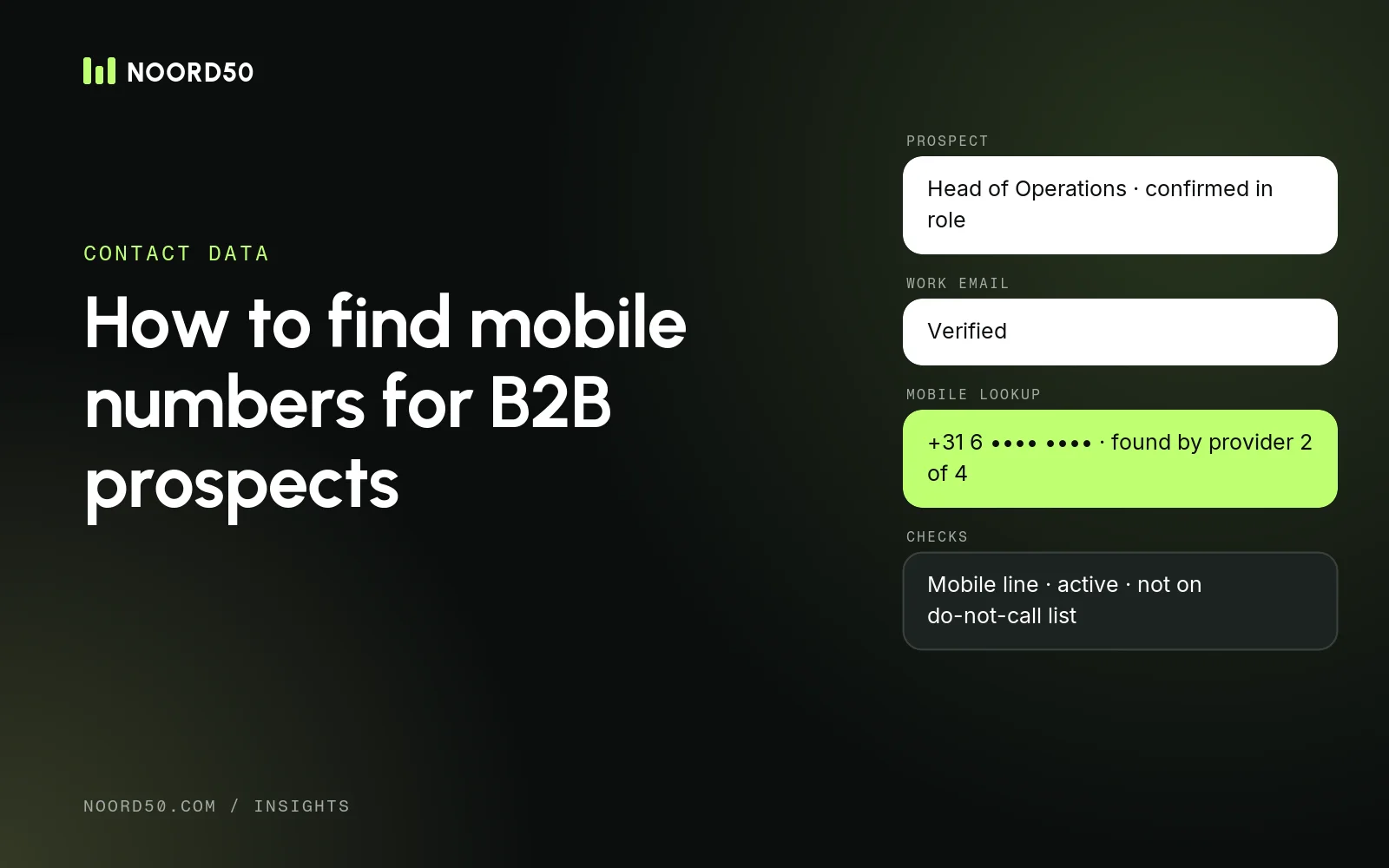
A step-by-step workflow
Step by step
A workflow for finding business mobile numbers
01
Confirm the person
Check they still work at the company and hold the role you want
02
Get a verified work email
Email plus profile URL makes phone matching more accurate
03
Run a mobile lookup
One provider, or a waterfall that tries several in sequence
04
Verify the number
Line type and activity check; call-verify for key accounts
05
Check the rules
Do-not-call lists, opt-outs and your lawful basis
06
Store the source
Record where each number came from and when
- Confirm the person. Check on LinkedIn that they still work at the company in the role you expect. Numbers of people who left are the most common waste of credits.
- Get a verified work email first. Most phone lookups match better with an email and profile URL than with a name alone.
- Run the mobile lookup. Start with your main provider; send the misses through a waterfall tool if the account is worth it.
- Verify. At minimum, check that the number is a mobile and active. For key accounts, a provider with call-verified numbers or your own quick verification call is worth the effort.
- Check the rules. Run numbers against the relevant do-not-call registers and your own opt-out list.
- Store the source. Record where and when you got each number. You’ll need it if someone asks, and it helps you judge providers over time.
How to verify phone numbers
Verification
Four ways to check a number before you dial
Line-type check
Is it a mobile, landline or VoIP number? Removes switchboards from a mobile list.
Activity (HLR) check
Asks the mobile network whether the number is active, without calling it.
Call verification
A person or provider calls to confirm who answers. Most reliable, slowest.
Recency
Prefer numbers that were confirmed recently; people change jobs and numbers.
Verification removes the obvious failures, but no method guarantees that the person picks up. Track connect rates per source in your dialler or CRM; after a few hundred calls you’ll know which provider works for your market.
GDPR and calling rules in Europe
A business mobile number of an identifiable person is personal data under the GDPR, including in B2B. That doesn’t make B2B calling impossible, but it does set conditions. This is a summary, not legal advice.
- Lawful basis. Most B2B prospecting relies on legitimate interest (Article 6(1)(f) GDPR). That requires a real business reason, a relevant contact, and a balancing test showing your interest doesn’t override theirs.
- Transparency. When you didn’t get the data from the person directly, Article 14 GDPR requires you to tell them where it came from and how to object, at the latest when you first contact them.
- Right to object. If someone asks you not to contact them, stop and record it, across all channels.
- Provider choice. Ask providers how they source and refresh data, whether they honour opt-outs and do-not-call lists, and where data is stored.
- National calling rules. These differ per country. In the Netherlands, consumers and small businesses such as sole traders need to have opted in for telemarketing calls since July 2021, while calls to companies fall under a B2B exception. In Germany, a sales call to a business needs at least its presumed consent under § 7 UWG. Belgium has the “Bel-me-niet-meer” do-not-call list, and the UK has the TPS and CTPS registers. We cover the DACH and Benelux differences in cold calling in DACH vs the Benelux.
Never try to get numbers through unauthorised access, such as scraping private profiles, using leaked data or tricking someone into revealing a colleague’s number. Besides the legal risk, it’s not how you want a first conversation to start.
When to buy numbers, and when to outsource the calling
If you call a few dozen key accounts a week, a single provider plus manual verification is enough. If calling is a core channel, the data is only one part: you also need callers who speak the language, a dialler, scripts per market and follow-up. That’s the model we run for clients, with native BDRs and data sourced and verified per campaign. See how pay-per-meeting outbound works, or read how many meetings an SDR can book per month to see what good data makes possible.
For more on contact data in general, see our comparison of B2B data enrichment tools.
Finding B2B mobile numbers: common questions
Is it legal to call a business mobile number in Europe?
Generally yes, if you have a lawful basis (usually legitimate interest), you’re transparent about where you got the number, and you respect opt-outs and national calling rules. Rules differ per country, so check the market you call into.
Can I find a phone number from a LinkedIn profile?
LinkedIn rarely shows phone numbers. Tools such as Prospeo, Kaspr and Lusha have Chrome extensions that look up a profile’s contact details in their own databases. They don’t read hidden data from LinkedIn.
Which tool has the best mobile coverage in Europe?
It depends on the country, industry and seniority you target. Test two or three tools on 100 people from your own list and compare numbers found and calls connected. At Noord50, Prospeo is our main database.
What is waterfall enrichment for phone numbers?
A waterfall sends each lookup to several providers in sequence and stops at the first verified result. It raises the share of contacts with a number found, usually at a higher price per number than a single provider.
Sources